
Mold in a crawl space, a lower-level room or an enclosed garage is a moisture problem first and a cleaning problem second. If you are dealing with it in La Palma, CA, the order of work matters more than the product you spray. Fix the water, contain the area, remove what cannot be cleaned, then dry everything.
First, check what your own house has. Some homes here may have a crawl space, a raised foundation with vents, a sunken room or none of these, and you should confirm yours before planning anything. Look at your plans, your inspection report or the underside of the floor.
Find the water before touching the mold
Mold needs moisture, organic material and time. Remove the moisture and the growth stops spreading, though existing material still has to be dealt with. Common sources in low spaces include a leaking drain or supply line, a clogged gutter that dumps water along the foundation, a dryer vent that terminates in the crawl space, and missing vapor barrier over bare soil.
Use a moisture meter on framing and subfloor, and a flashlight on pipe joints. Note any musty smell, dark staining on joists or fuzzy growth on insulation. Photograph all of it first.
Dryer vents, bathroom exhaust ducts and condensation on cold pipes are other moisture sources people miss. A hygrometer left in the space for a few days tells you whether the air stays damp.
What a homeowner can handle
EPA guidance treats a patch smaller than roughly 10 square feet as something many people can manage on their own. Wear an N95 respirator, gloves and eye protection. Scrub hard, non-porous surfaces such as sealed concrete or plastic with detergent and water, then dry them fully.
Do not use bleach as the fix. Porous items such as insulation, carpet and ceiling tile that have visible growth are normally bagged and discarded.
Work from the outside in, bag waste inside the space and wash your hands and clothes afterward.
Safety in tight and low spaces
A crawl space is a confined area with low clearance, loose soil and sometimes exposed wiring. Turn off power to any wet circuit before you go in, wear knee pads and a head covering, and tell someone where you are. If the space holds standing water, stay out until the power is confirmed off.
Pests, old pipe wrap and sagging floor joists are other reasons to be careful. Keep children and pets away from the entrance while work is under way. In an enclosed garage, never run a gas-powered fan or pressure washer with the door shut.
Where to stop and call
Hand the job to a mold crew when any of these apply.
- The growth covers more than about 10 square feet or keeps returning after cleaning.
- The cause was sewage, flood water or a long unnoticed leak.
- Structural wood, such as joists or the sill plate, looks soft or sagging.
- HVAC ducting runs through the affected space.
- Anyone in the home has questions about their health. Those belong with a physician.
- The materials are old and may contain asbestos or lead. Ask before disturbing old ceiling texture or old flooring.
How professional removal is staged
Crews working to ANSI/IICRC S520, the published standard for mold remediation, set up containment with poly sheeting and run HEPA air scrubbers to hold negative pressure. Workers wear respirators and protective suits. Affected porous materials are removed and bagged, and framing is cleaned with HEPA vacuums and damp wiping or abrasive methods.
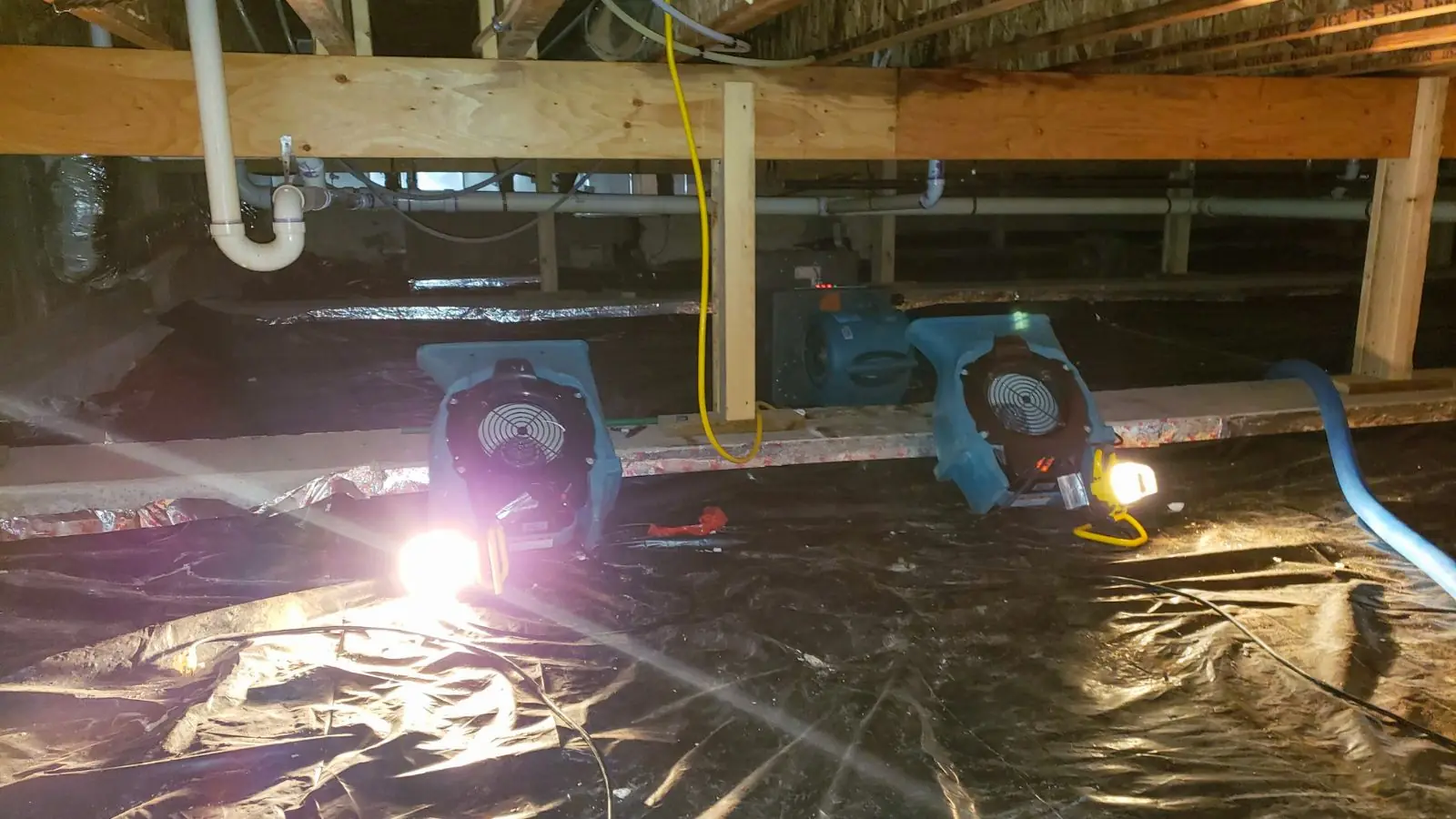
Drying follows, using air movers and dehumidifiers until readings match unaffected areas. See our mold remediation page for how the stages fit together.
Ask the crew to show you photos of the framing before and after cleaning, plus the final moisture readings.
Space by space
| Space | Typical trouble | Typical removal approach |
|---|---|---|
| Crawl space | Damp soil, leaking pipes, blocked vents, wet insulation | Remove wet insulation, repair the source, clean framing, add or repair vapor barrier |
| Lower-level room | Wall moisture, floor drain issues, wet carpet | Pull wet drywall and flooring, contain, clean studs, dry before rebuild |
| Enclosed garage | Stored cardboard, a leaking water heater, wet slab edges | Discard wet porous items, fix leaks, clean and dry the slab and wall base |
Confirm the crawl space entrance is safe. Confined spaces can hide electrical hazards, standing water and pests, so turn off power to wet circuits first.
Vapor barriers and vent openings matter after cleanup too. If bare soil is exposed, a sheet of heavy plastic over it and clear foundation vents reduce the moisture that rises into the space.
Clearance testing and rebuild
After removal, an independent tester who does not profit from the cleanup can sample the area. This is called clearance testing, and you can request it. It confirms the work met the written scope rather than relying on a visual check.
Rebuild only after readings show dry materials. If the cause was a leak, a water damage repair contractor can handle the drywall, insulation and flooring.
Keep the clearance report, the scope and the invoices together. A future buyer or insurer may ask for them.
La Palma notes for permits and planning
City Hall is at 7822 Walker Street, and the number is (714) 690-3300. It is open Monday to Thursday from 7:30 am to 6:30 pm and closed on Fridays. Permits sit with the Community Development department, so plan any call or visit for early in the week.
Permit rules vary, so ask the city building department whether your work needs one before demolition or rebuild begins. Remediation itself may not, but structural repair, plumbing or electrical work in a low space often does. Bring a short scope and photos to save time.
Ask your mold contractor whether your state licenses mold work and what that means for the scope. For help in neighboring areas, the same process applies in Cerritos and Anaheim. Keep your permit and clearance paperwork with the house records.
Common questions
Is mold in a crawl space dangerous to the house?
It can be when moisture is long term. Wood framing that stays wet can soften and lose strength, and insulation that holds water stops doing its job. Have joists and the sill plate probed for softness before assuming the problem is cosmetic.
Can I just paint over or seal mold in a low room?
No. Coatings do not stop mold that is still fed by moisture. Remove the growth, fix the source, and dry the area before anything is sealed.
Do I need a test before removal?
Not always. Visible growth with a known water source is often scoped by inspection alone. Clearance testing after the work is the step many people request, and it should be done by someone independent of the crew.
In La Palma, who do I contact about permits for crawl space repairs?
Start with the Community Development department at City Hall on Walker Street. Call (714) 690-3300 Monday to Thursday, since the office is closed Fridays. Ask what documents they want for the work you plan.
Still have a question about your situation? Call (714) 515-1308 and a dispatcher will talk it through, day or night.