
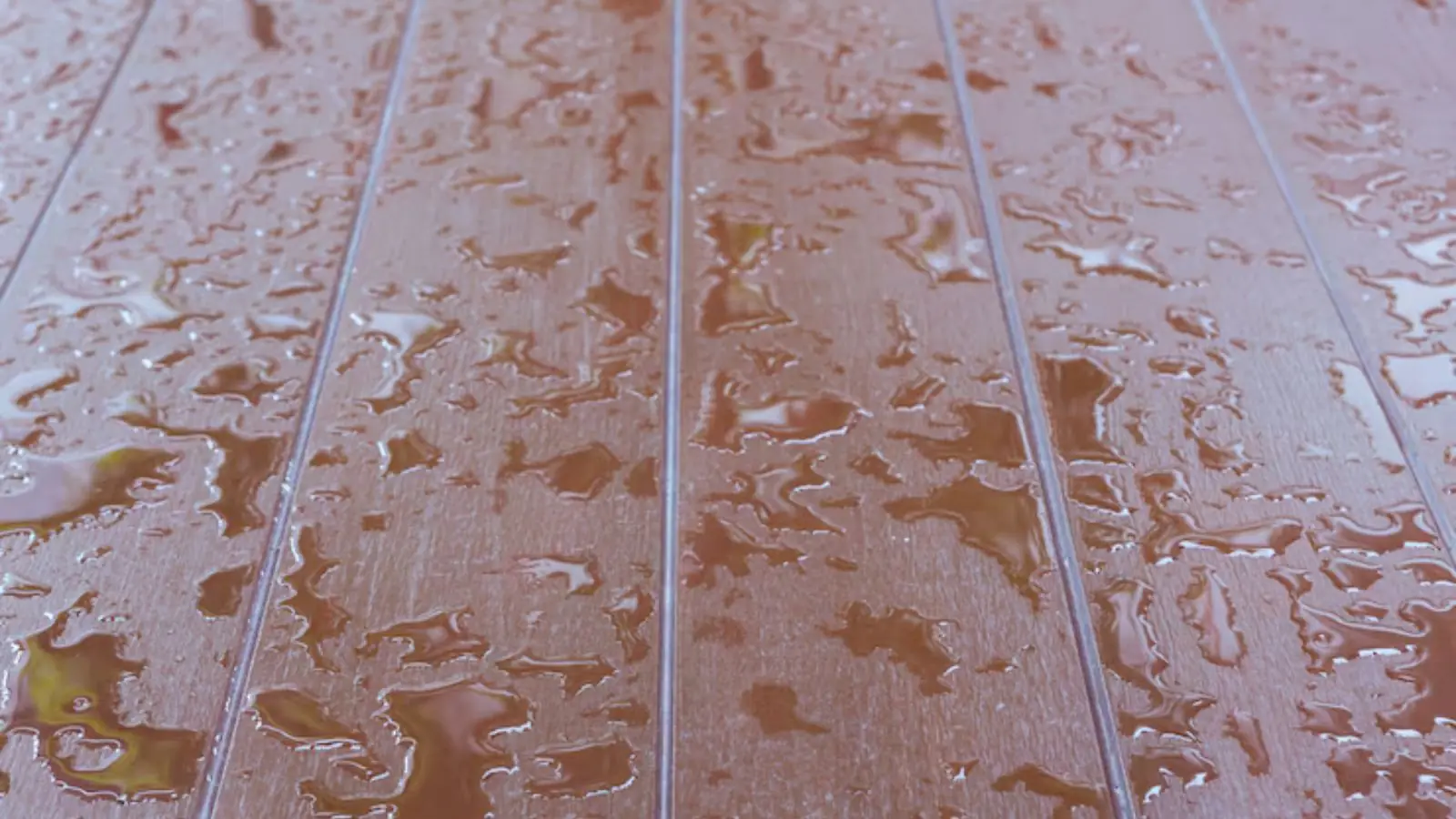
Water damage to a wood floor in La Palma, CA rarely looks the same twice. A dishwasher leak can lift one corner of a kitchen, while a slow plumbing drip can warp boards across a hallway. The shape of the damage tells a trained eye a lot about how long the water sat.
Boards cup, crown, and buckle for different reasons, and each one points to a different repair path. This article explains those terms, when drying mats can save a floor, when replacement is the honest answer, and why the subfloor decides more than the boards do.
Cupping, crowning, and buckling explained
Cupping means the board edges rise higher than the center, creating a shallow trough. It happens when the bottom of a board absorbs more moisture than the top. Crowning is the opposite, with the center higher than the edges, and it often shows up after a cupped floor was sanded before it finished drying.
Buckling is the severe stage. Boards lift away from the subfloor, sometimes several inches, because the whole floor has swollen and run out of room. A buckled floor needs fast attention, since the fastening system has usually failed.
What kind of floor you have
Solid hardwood, engineered wood, and laminate all react differently. Solid boards are the most forgiving and can often be dried and refinished. Engineered wood has a thin wear layer over plywood layers, so it can delaminate and cannot be sanded many times. Laminate has a fiberboard core that swells and rarely recovers.
Floor installation matters too. Boards nailed to a plywood subfloor behave differently from floating floors over foam, and glued-down floors over a concrete slab trap moisture underneath. Say which one you have when you call, because it changes the equipment and the odds.
When drying mats and panels make sense
Floor drying systems pull moisture out through the board surface using mats or panels connected to a vacuum or high-pressure air line. They work best on solid hardwood when water was clean and the floor has been wet for a short time. Air movers and LGR dehumidifiers run alongside, since the room air has to take up what the floor releases.
Success depends on daily moisture meter readings. If the boards are dropping toward the reading of an unaffected area of the same species, the floor is on track. If numbers stall or boards keep moving, stop forcing it and plan the replacement.
Drying versus replacing
The table below is how many estimators think through it. Real calls depend on the meter and on what is under the boards.
| Condition | Likely path |
|---|---|
| Light cupping, clean water, caught quickly | Dry with mats and dehumidification, wait for movement to settle, then sand and refinish if needed |
| Cupping across the room after days of wetness | Try controlled drying, but plan for board replacement in worst areas |
| Buckled or detached boards | Remove affected sections, inspect and dry subfloor, then reinstall or replace |
| Engineered or laminate with swollen edges or peeling layers | Usually replace the affected area, since swelling is not reversible |
| Gray or black water contact | Remove and dispose of the flooring, then clean and treat the subfloor under ANSI/IICRC S500 |
The subfloor and what sits under it
Plywood or OSB under the boards soaks up water slowly and releases it slowly. Even when the top looks flat, the subfloor can stay damp for days, and finishing a floor over a wet subfloor causes the cupping to return. Meters that read through the surface are a first pass, but lifting a board or two at the edge gives a true read of what is below.
Crawlspaces and slabs bring their own issues. A crawlspace should be checked for standing water and wet insulation. On a slab, ask whether moisture rises from the concrete, because a flooring failure there is not always a plumbing leak.
Safety before anyone steps on it
Turn off power to affected outlets and baseboard heaters before you work on a wet floor. Keep children and pets out, because buckled boards leave sharp edges and nail points. If the water came from a backup or outside flooding, avoid contact, since that is contaminated and the flooring is generally removed.
Old flooring needs one more caution. Ask before disturbing old floor tile, old adhesive, or the layers beneath a worn floor, since some older materials can contain asbestos. A lab test before demolition is the safe order.
Refinishing and finishing steps
Refinishing should wait until the boards and the subfloor read dry and stop moving. Sanding too soon crowns the floor as the remaining moisture leaves. Waiting an extra week or two is cheaper than sanding twice.
Once readings hold steady, the order is repair gaps, sand, stain if you want a color match, and apply finish coats. Replacement boards are blended into the field and stained to match. Matching an old, sun-faded floor is hard, so ask to see a sample in your room light.
If you have a leak now, a quick emergency water removal visit before the water spreads under the baseboards can save a floor that otherwise needs replacement.
La Palma notes for wood floor damage
La Palma Avenue is the main thoroughfare, and it runs past homes, businesses, La Palma Intercommunity Hospital, John F. Kennedy High School and Walker Junior High School. Those buildings do not share one floor type or one flood response. A house with oak boards over a plywood subfloor is a different job than a school corridor or a hospital floor, and we make no claims here about how those buildings are floored or managed.
For a home, that means the questions are practical. What is the floor made of, what is under it, and where did the water come from? Answer those three before choosing mats, replacement, or a full tear-out.
If water has spread past your property or into a shared wall, flood damage restoration may involve more rooms than you expect. Crews serve neighboring Cypress and Cerritos as well, and the same floor questions apply there.
Common questions
Will a cupped wood floor flatten on its own?
Often it will if the cause was short and the boards dry slowly and evenly. Give it weeks, not days, and keep the room's humidity steady. Do not sand until boards and subfloor read dry.
How soon should wet wood floors be dried?
As fast as possible. EPA guidance says damp materials dried within 24 to 48 hours generally will not grow mold, so that is the practical window. After that, the odds of replacement go up.
Can I tell if the subfloor is wet from above?
Not reliably. A surface meter gives a clue, but lifting a board or checking from below through a crawlspace gives the real answer. Ask the crew to show you the subfloor readings.
Does the type of building along La Palma Avenue change how a floor is handled?
Yes. A home with wood boards and a school or hospital building are different jobs, and the facility staff there set their own procedures. For a home, the key questions are the floor type, the subfloor, and the water category.
Still have a question about your situation? Call (714) 515-1308 and a dispatcher will talk it through, day or night.